
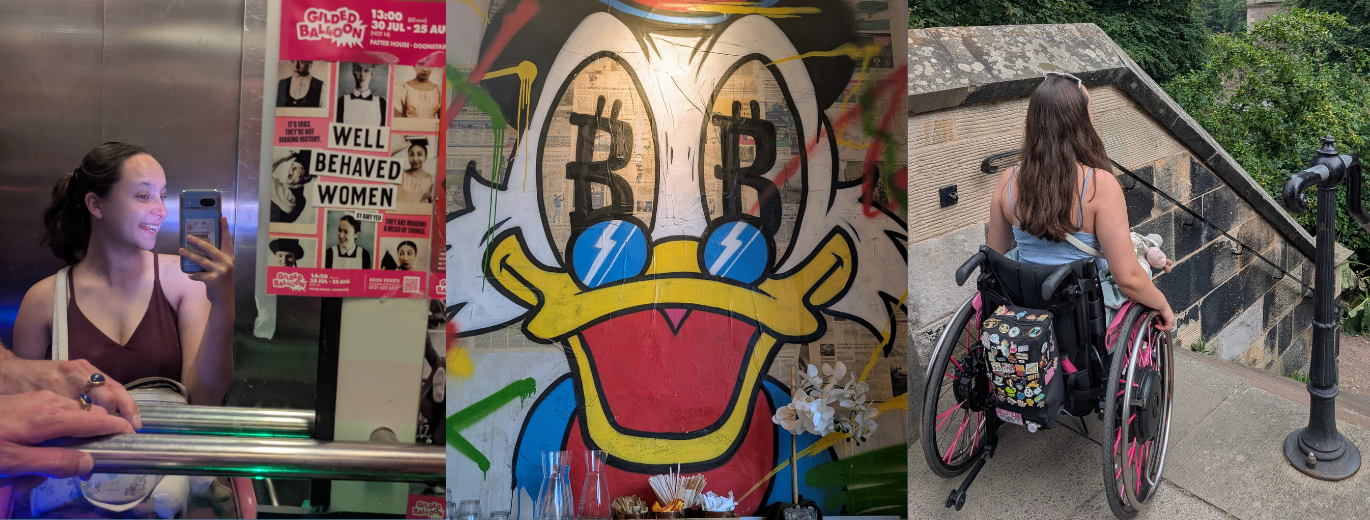
Travel Blog Enjoying the Edinburgh Fringe
Imagine this: you're a wheelchair user navigating the busiest cultural hub in the UK at its most popular time of year and it's in the middle of an old cobbled city... It's hard going!
The Edinburgh Fringe is the world’s largest arts festival which runs for a whole month every August in Scotland’s capital. It showcases performances of all types, from puppetry to plays, magicians and musicals. As a theatre fan, I have always loved going to see as many new productions as possible - however things got much harder once I became disabled.
Edinburgh is about 900 years old, meaning that the infrastructure features lots of incredibly steep hills, narrow pathways, and pavements with no dropped curbs. This makes it quite tricky to navigate using a mobility aid, especially with (genuinely) millions of people to weave in and out of at the same time. This year was particularly mobbed due to the Oasis concerts and the Tattoo Anniversary celebrations all happening simultaneously!
This is why the AccessAble Detailed Access Guides have been an absolute lifesaver during my trip and I have almost exclusively visited venues where extensive information has been provided about the accommodations available for disabled guests. It just takes too much time and effort to travel all the way to somewhere new when you don’t know if you’ll even be able to get in or not.
Step One - Planning
Accommodation:
I was lucky enough to stay with family friends so I didn't have to find a hotel or B&B, but there are many of these that come with Detailed Access Guides should we have needed them!
The Shows:
Lecture halls, churches, and conference rooms are all transformed into performance spaces so most venues on the Fringe Website are not listed under the same name on AccessAble, however many of the buildings are covered by their Detailed Access Guides! For example, getting to any of the shows in or around George Square is made easier by this one.
Transport:
Even though there are Detailed Access Guides for many London airports, I find flying as a wheelchair user so stressful and avoid it if there is literally any other option! I have seen other AccessAble Ambassadors post about their cross country travel before so I knew that AccessAble also provide guides for many major train stations too, and so I decided to go down that route and head into Edinburgh Waverley:
The guide for Edinburgh Waaverley in particular features links to helpful resources which I used in conjunction with the Passenger Assist app to ensure I was well prepared for my journey.
Step Two - Getting There
Unfortunately, our train was delayed and there was very little communication from the King’s Cross staff on our departure end - so it doesn’t seem like a coincidence that this was one of the only main stops on our travels that didn’t have an AccessAble Detailed Access Guide. However, the LNER team were wonderful and made sure we got on board safely and comfortably.
Then our suitcase broke as soon as we arrived, so I scrambled for the nearest store with a Detailed Access Guide to get ourselves sorted and luckily the city’s main mall has lots of them! We headed to John Lewis on the 1st floor of the St James Quarter shopping centre and were thrilled to find that not only did every lift and escalator work (with 2 sets of wheels in tow, this really is imperative) but all of the staff were very well versed in the accommodations detailed in the guide and how I could best find my way around using it to help.
Step Three - Enjoying the Trip!
We decided to do a proper food shop on our first day so we didn’t have to navigate lots of cafes and restaurants throughout the week - the combination of how many people and places it takes to find meals on the go is just too exhausting with a chronic illness so we opted for packed lunch instead! To take the mental load off finding an accessible supermarket, we just searched through our options on the AccessAble website. These were mostly express shops where we might have preferred a larger one to offer more choice and avoid those convenience costs, however it was worth it for the proximity to our accommodation and ease of navigating.
In saying that, I do require frappes to function so we did stop in at the local coffee shop, Gordon Street Coffee, quite a few times.
There were all the normal barriers: accessible exits were blocked, bathrooms were used as set storage spaces, and the only place to leave your wheelchair when transferring to a seat at a show was often by a bin or completely blocking people’s way! The biggest difficulty was when I had to ring a bell to request the ramp at venues with a large step at the door, only to find it broken multiple times and have to send my partner in to find someone instead. I can’t go on adventures like this alone anyway, but if I could be independent and was here by myself I would have been completely stuck!
On a more positive note there were some really innovative solutions where staircases turned into platform lifts, and it was so nice to see art literally everywhere you looked when zooming between shows.
The complete highlight of my week was supporting my friends in their shows, made possible only by the fact their venue, National Museaum of Scotland, had an AccessAble Detailed Access Guide!